Similarweb Alternatives: 4 Market Intelligence Tools Tested
Summary
Looking for Similarweb alternatives that do more than estimate traffic? We compared Semrush, Ahrefs, SparkToro and SpyFu on starting price, market-share benchmarking and audience-behavior data, the one thing Similarweb doesn't touch. Semrush wins on feature parity at a lower entry price. SparkToro wins if traffic size was never the real question. Screenshots and G2 ratings included, dated September 2026.
Similarweb answers one question well: how much traffic does a domain get, and where does it come from. It does not tell you who those visitors are, what they were trying to solve, or whether a smaller, cheaper tool would answer your actual question faster. We compared four Similarweb alternatives, Semrush, Ahrefs, SparkToro and SpyFu, on price, market-share benchmarking and audience-behavior depth. Semrush wins for teams that want to replace Similarweb outright: same traffic-benchmarking core, lower entry price, plus SEO and PPC tooling bundled in. SparkToro wins for a different job entirely: finding out who your audience actually is, not how big a competitor's traffic number is.
What Similarweb actually measures, and where that stops being enough
A founder sizing a new market types a competitor's domain into Similarweb and gets an estimated monthly visit count, a traffic-source split, and a market-share chart against a handful of named rivals. That's a real, useful signal. It's also a proxy. Similarweb estimates traffic from a mix of panel data, ISP partnerships and clickstream modeling, not from a direct feed off the sites it measures. Numbers on smaller or newer domains carry wider error bars than the polished dashboard suggests.
More importantly for the audience reading this: traffic volume is not the same as audience fit. Two competitors can pull identical monthly visit counts and have almost nothing in common in who those visitors are, what they searched to get there, or what they were frustrated about before they landed. Similarweb was never built to answer that second question. None of the four alternatives below fully replace it either, but each one trades traffic breadth for a different kind of depth.
Who ranked where, and why
Semrush and Ahrefs are the two tools most often cited alongside Similarweb in the same sentence, and for good reason: both estimate organic traffic, both let you benchmark a competitor set, and both are backed by review volumes in the hundreds or thousands on G2. Semrush's Market Explorer module is the more direct Similarweb substitute of the two, built explicitly for competitor and market-share comparison rather than SEO auditing first. Ahrefs leads on backlink and keyword-database depth, the areas where SEO practitioners rate it highest, but its traffic numbers are explicitly modeled estimates rather than a market-intelligence product in their own right.
SpyFu sits in a narrower lane: competitor keyword and ad-history research, priced for a solo marketer or small PPC team rather than an enterprise insights function. It will show you exactly which keywords and ad copy a rival has run, historically, which none of the other three tools do as thoroughly. What it will not do is estimate a market's overall size.
SparkToro is the odd one out, deliberately. It does not estimate traffic at all. It answers a question closer to the one Crowd Scope itself is built around: not how big is this market, but who is actually in it, and where do they spend their attention. For a founder validating a new ICP segment, that can matter more than a traffic number ever will.
Once a market-intelligence tool has told you which 3-5 competitors to watch, the next problem is finding the actual people who are frustrated with what those competitors do, by name, with a URL and a date attached. That's a different layer of research than any of the five tools in this comparison were built to run.
The dominant use case: which tool actually answers your question
Most people typing "Similarweb alternatives" into a search bar fall into one of three buckets. The first wants a cheaper way to run the exact same traffic-and-market-share workflow: for that person, Semrush is the direct swap, at a lower entry price and with more bundled tooling. The second wants deeper SEO and backlink data and was only using Similarweb's traffic view as a side feature: Ahrefs fits better, with the caveat that its own traffic estimates are directional, not a market-sizing product. The third bucket, underserved by every traffic tool on this list, wants to know who their market actually is before they spend a dollar sizing it: SparkToro is built for exactly that, at a fifth of Similarweb's entry price.
SpyFu earns its place for a fourth, narrower group: teams running paid search who need a rival's exact keyword and ad history more than a market-share chart. It is the cheapest tool in this comparison at $39 a month, and the least useful of the four if market sizing was the actual goal.
Where each tool breaks down in practice
None of these are free rides. Similarweb's own free plan is capped hard enough that most serious research pushes straight to the $199/month Starter tier, the most expensive entry price of the five tools in this comparison. Semrush bundles so much into one subscription that a team hired only to benchmark competitor traffic ends up paying for SEO and social modules it may never open. Ahrefs raised its Lite-plan price roughly 30% since 2023, narrowing what used to be a clear cost advantage over Semrush. SparkToro's biggest limitation isn't price, it's scope: it has no traffic-volume number at all, and teams that need one alongside audience data will end up running two tools, not one. SpyFu's core weakness is geographic: its entry-tier data defaults to the US market, a real gap for anyone researching European or APAC competitors.
We're also flagging a limit in our own research here, on purpose: SparkToro carries only 13 reviews on G2 as of September 2026. That is not enough of a sample to treat its star rating with the same confidence as Semrush's 4,039 reviews or Ahrefs' 715. We report the number because a thin sample is still a real signal, just a weaker one, and pretending otherwise would be exactly the kind of unearned confidence this comparison is trying to avoid.
What we'd pick, and when we'd pick something else
For a growth team or PMM that wants to keep doing what Similarweb does, cheaper, and get SEO and PPC tooling in the same login, Semrush is the pick. For an SEO-first team where competitor traffic was always a secondary signal, Ahrefs' keyword and backlink depth outweighs Semrush's broader-but-shallower feature spread. For a PPC team that lives and dies by a rival's ad copy and keyword history, SpyFu's $39/month entry price is hard to beat, provided the research stays US-focused. And for the founder or PMM validating a brand-new ICP segment before committing budget to any of the above, SparkToro answers a question the other three don't ask: not how big is this market, but who is actually in it.
The honest answer to "what's the best Similarweb alternative" depends entirely on which of Similarweb's jobs you're actually trying to replace. Pick the tool that answers your real question, not the one with the biggest traffic-number dashboard.
At-a-glance
| Semrush | Ahrefs | SparkToro | SpyFu | |
|---|---|---|---|---|
| Primary data type | Traffic Analytics plus a full SEO/PPC/content/social suite | Backlink and organic-keyword database, directional traffic estimates | Audience behavior: sites, podcasts, social accounts your audience follows | Competitor paid and organic keyword history, including past ad copy |
| Market-share benchmarking | Yes, Market Explorer benchmarks up to 5 rivals | Limited to shared/missing keywords, not traffic share | No, not built for traffic-share benchmarking | No, keyword-level view only |
| Starting paid price | $139.95/month (Pro), $117.33/month billed yearly | $129/month (Lite plan) | $38/month; free plan gives 20 searches/month | $39/month (Basic plan) |
| Audience-behavior detail | Partial: demographic and traffic-source splits only | Not covered | Full: podcasts, sites, social accounts by audience segment | Not covered |
| G2 rating (Sep 2026) | 4.4/5 across 4,039 reviews | 4.5/5 across 715 reviews | 13 reviews only, too thin a sample to trust | 4.6/5 across 518 reviews |

Semrush
- Traffic Analytics plus a full SEO, PPC, content and social toolkit in one $139.95/mo Pro seat
- Market Explorer benchmarks up to 5 rivals on traffic, audience overlap and growth quarter over quarter
- 4,039 G2 reviews at 4.4/5 as of September 2026, the largest verified user base of the five tools compared here
- The Pro plan's 500 tracked keywords and daily analytics-request caps run out fast for agencies managing several accounts
- So many bundled modules that a team hired only for traffic benchmarking pays for SEO and social tools it may never open
Closest feature-for-feature swap for Similarweb, at roughly $60/month less for the entry paid tier.
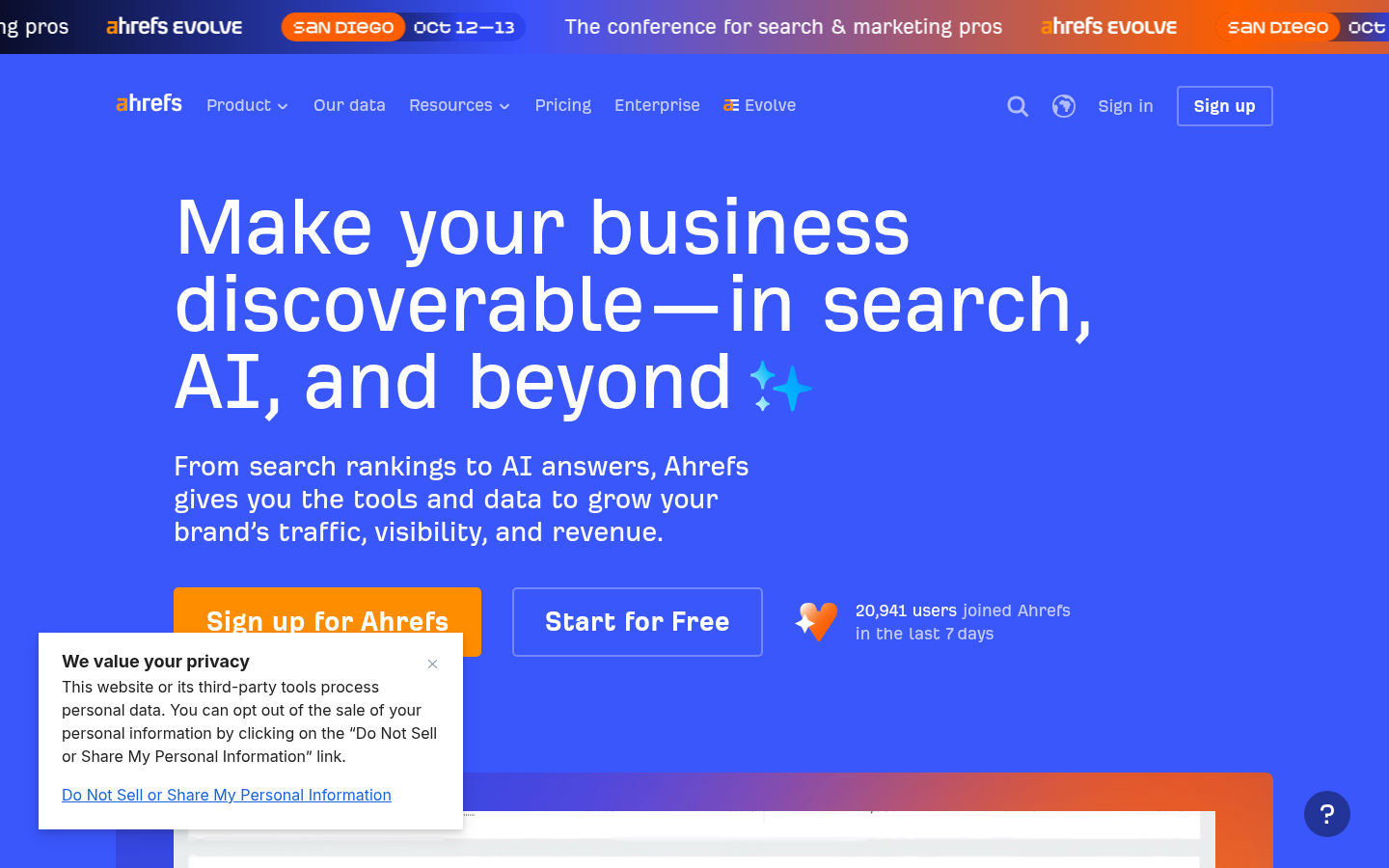
Ahrefs
- Backlink index and organic-keyword database are widely cited as the deepest in the category
- Competitive Analysis compares up to 5 domains on shared and missing keywords in one report
- 4.5/5 on G2 across 715 reviews as of September 2026, the highest star rating of the five tools here
- Traffic estimates are directional, modeled from clickstream and keyword data, not a substitute for Similarweb's market-share view
- Lite plan pricing rose roughly 30% since 2023 to $129/month, narrowing the gap with pricier suites
Best keyword and backlink data of the group, weakest fit if market share is the actual question.

SparkToro
- Answers a question none of the traffic tools do: what podcasts, sites and social accounts your audience actually follows
- Entry paid tier starts at $38/month, a fraction of Similarweb's $199/month Starter plan
- Free plan allows 20 searches a month, enough to validate a new ICP segment before paying anything
- No traffic-volume or market-share numbers at all: it will not size a competitor's site traffic
- Only 13 reviews on G2 as of September 2026, too small a sample to treat its star rating as a reliable signal
Not a market-share tool. The best of the five for finding where a specific audience segment actually spends time.
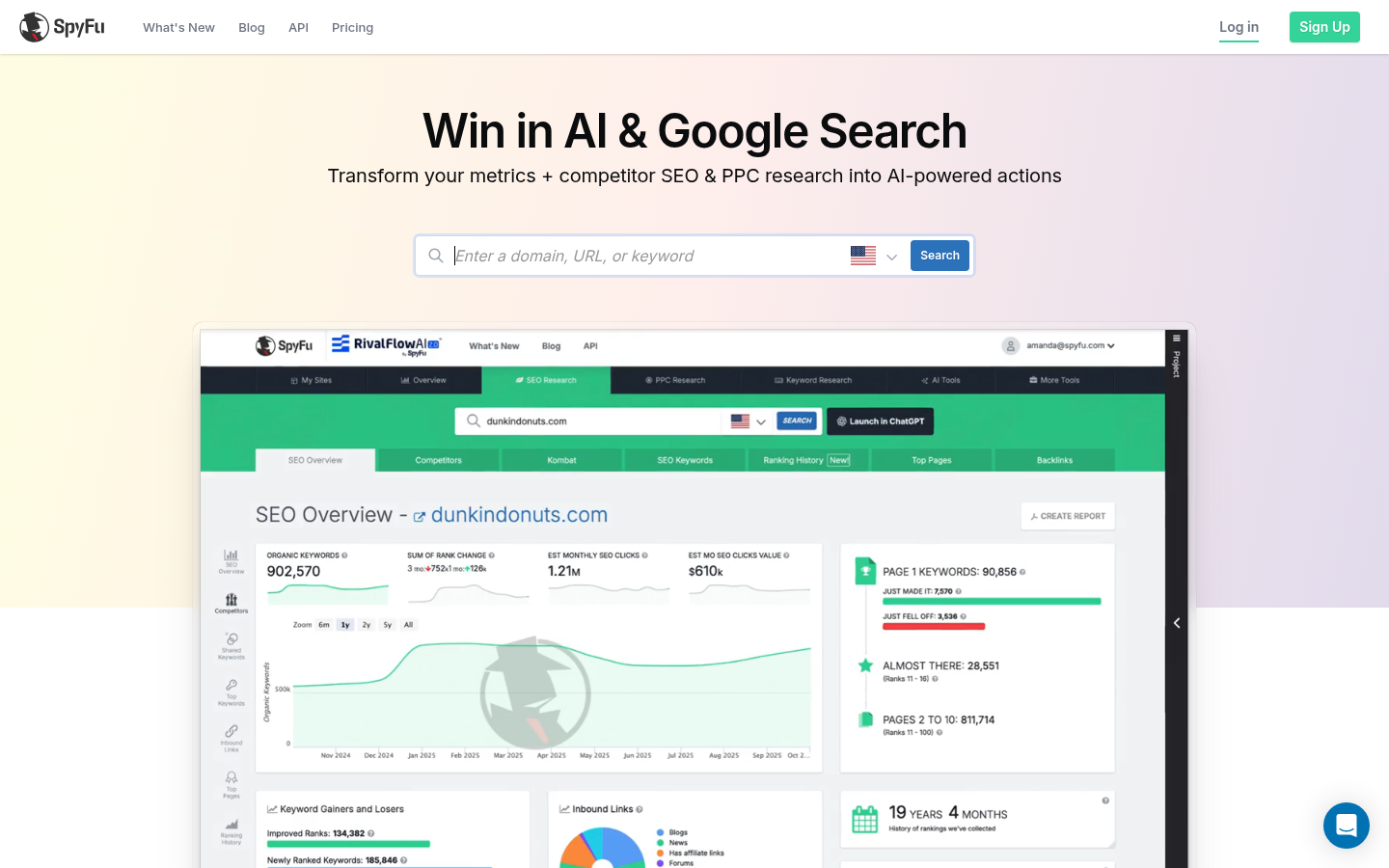
SpyFu
- Full paid and organic keyword history for any domain, including past ad copy, at $39/month for the Basic plan
- 4.6/5 on G2 across 518 reviews as of September 2026, the highest rating of the five, on a smaller review base than Semrush
- Unlimited domain lookups on paid plans, no per-lookup credit system to track
- Entry-tier data defaults to the US market, a real gap for teams researching European or APAC competitors
- No market-share or audience-overlap view: it answers which keywords, not how big a market is
Cheapest entry price of the five, but the narrowest scope: keyword and ad intelligence only.
Verdict
Semrush is the closest feature-for-feature Similarweb alternative: traffic benchmarking plus a full SEO and PPC suite, for about $60 a month less than Similarweb's own entry plan. Ahrefs beats it on keyword and backlink depth. SpyFu beats it on price for pure keyword intelligence. SparkToro is the outlier: it does not estimate traffic at all, and it is the only one of the four that answers a different, often more useful, question for early-stage teams: who is your audience, really, and where do they already spend time.
How we tested
We compared each tool's own pricing page, plan structure and feature list as published in September 2026, cross-checked against third-party pricing trackers (DemandSage for Semrush, ITQlick and Bestever for SpyFu, explodingtopics for SparkToro) where the vendor page listed a promotional rather than list price. Review-volume and star-rating figures are pulled directly from each product's G2.com listing, read on the same day, and reported with the exact review count so a 13-review average (SparkToro) is not presented with the same confidence as a 4,039-review average (Semrush). We did not run our own multi-week traffic-accuracy test across the five tools; where a claim about data depth or coverage isn't ours to measure, we say so instead of inventing a number. Screenshots are live captures of each product's homepage taken during this review.