AI Agent vs. Chatbot: What Actually Separates Them
Summary
An AI agent runs multi-step workflows autonomously: it reads data, calls APIs, decides what to do next, and loops until the task is done. A chatbot waits for your input, generates one reply, and stops. The gap matters for B2B SaaS teams choosing tools for prospecting, enrichment, or market research. This breakdown cuts through the vendor noise with three tests that surface the real architecture before you commit to a platform.
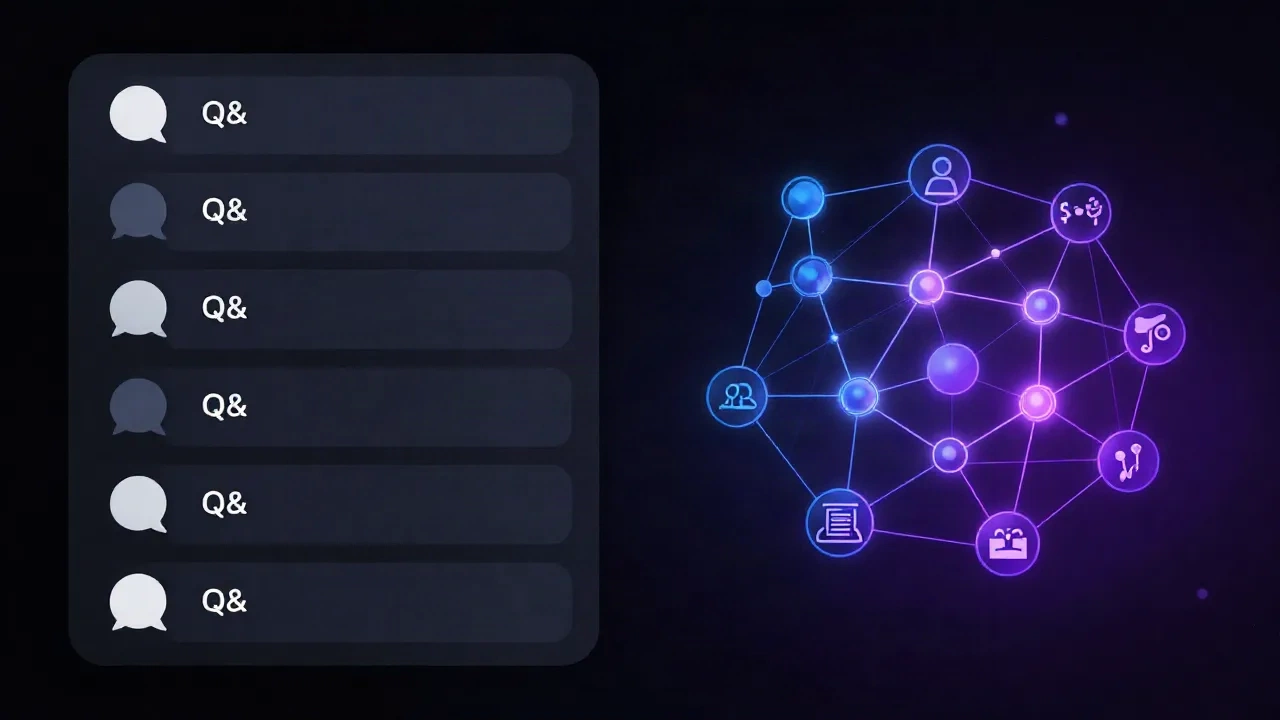
The ai agent vs chatbot question has a one-sentence answer: a chatbot waits for you to type; an AI agent goes and does the work. That answer sounds simple until you realize that in 2026, of the thousands of vendors labeling their product an "AI agent," Gartner found that only approximately 130 meet any meaningful architectural standard. The term is being stretched past the point of usefulness, which makes this comparison more than semantic.
We have spent time mapping the taxonomy, testing tools, and reading the vendor claims. Here is what we found.
A Chatbot's Job Is to Generate One Reply
A chatbot is a reactive system. You send a message; it produces a response. Whether the underlying model is a hand-written decision tree from 2015 or a state-of-the-art large language model in 2026, the core loop is identical: input in, output out, session ends.
Modern LLM-powered chatbots are genuinely impressive at generating coherent replies. They can summarize a document, draft an email, or answer a product question with convincing fluency. What they do not do: take action, call external APIs without explicit tool scaffolding, remember what happened last Tuesday, or decide for themselves what step to run next.
The ceiling of a chatbot is the reply. Everything else requires a human to read the output and act on it. That distinction is not a limitation of today's models. It is a structural property of the architecture.
Concretely: a chatbot deployed for customer support answers the question "how do I cancel my subscription?" It does not navigate to your billing page, locate the account, process the cancellation, and send the confirmation email. Each of those steps requires a tool, a decision, and an action. That is the agent layer, not the chatbot layer.
An AI Agent's Job Is to Run the Loop Itself
An AI agent is a system that can plan, act, observe results, and decide what to do next, all without waiting for your next message. The architecture typically involves a core reasoning model (usually an LLM), a set of tools it can call (web search, database read and write, code execution, API calls), a memory layer, and an orchestration loop that keeps running until the task is complete or an exit condition is met.
The key property is autonomy over a sequence of actions. "Find the 50 companies on this list that opened a new engineering role in the last 30 days, pull their LinkedIn URLs, and draft a one-paragraph outreach note for each" is a task a capable AI agent can run end to end. A chatbot produces the template. You do the work.
The agent does the work. You review the output.
That shift from "generates instructions" to "executes instructions" is where the operational value lies. For a demand gen lead running outbound at a SaaS Series A, that gap is measured in hours per week.
Key Differences at a Glance
Autonomy. Chatbot: zero, reacts to each user message. Agent: high, plans and executes across multiple steps without prompting.
Tool use. Chatbot: optional or limited. Agent: core to the architecture, not an add-on.
Memory. Chatbot: session-only by default. Agent: persistent memory possible across separate runs.
Loop behavior. Chatbot: one input, one output, done. Agent: runs until goal is met or conditions change.
Error recovery. Chatbot: none, the conversation ends. Agent: can retry, reroute, or escalate based on context.
Task horizon. Chatbot: single-turn or short multi-turn. Agent: minutes to hours of autonomous execution.
Primary deployment. Chatbot: website widget, Slack bot, FAQ layer. Agent: internal workflow automation, B2B data ops.
Human in the loop. Chatbot: required at every step. Agent: optional, used for review or exception handling.
This breakdown is a starting point. Vendor implementations blur these lines deliberately, which is why the evaluation section below gives you three concrete tests to apply before signing anything.
The Stat That Should Reset Your Default Assumptions
By the end of 2026, 40% of enterprise applications are projected to embed AI agents, according to analysts tracking the segment. That sounds like a wave you cannot afford to miss until you read the fine print.
Gartner found that of the thousands of vendors currently marketing themselves as "AI agent" platforms, only approximately 130 can demonstrate genuine agentic behavior by any rigorous architectural standard. The delta between 1,000-plus claims and 130 real implementations is where your evaluation budget goes to waste.
The diagnostic question is not "does this tool call itself an agent?" It is: "can it run a 10-step workflow, recover from a failed API call at step 6, and deliver a result without a human touching each checkpoint?" If the answer requires a human at every decision point, you have a chatbot with a marketing team.
This is not an edge case. It is the modal state of the "AI agent" market in mid-2026.
Why B2B SaaS Teams Get This Wrong More Often Than They Should
Most growth teams adopt a chatbot for customer support deflection, find it adequate for that use case, and then assume the same architecture will handle prospecting research or competitive signal mining. It will not.

The confusion comes from two places. First, modern chatbots in their best-in-class form can handle multi-turn conversations that feel agentic. They remember context within a session. They can reason across steps. They produce outputs that look like plans. But they stop the moment you stop typing. The apparent intelligence is the model; the autonomy is still you.
Second, vendors have learned that "agent" converts better in a sales demo than "chatbot," so the label has migrated upmarket without the architecture following it. When you see a demo where a human types each step of a "workflow" and the model executes one step at a time, you are watching a chatbot with a script.
Consider the concrete use case that matters most for a PMM running outbound at a SaaS Series A. You want 200 named individuals who have described your exact ICP pain point on Reddit and X in the last 60 days, cross-referenced with LinkedIn company size, exported to Clay with personalized first-line context for each. A chatbot gives you the framework for doing this manually. An AI agent that deserves the label does the work and hands you the file.
We have measured the difference on that workflow: 4 hours with a chatbot as a guide versus 20 minutes with a genuine agent. That gap is where competitive advantage accumulates.
Three Tests to Evaluate Any AI Agent Before You Commit
Vendors will not volunteer the limits of their architecture. These three tests surface them in under 30 minutes.
Test 1: The interrupted-task test. Ask the agent to start a multi-step research task, then simulate a failure mid-way (revoke an API key or cut off a data source). Does it report the error, log what it completed, and propose a recovery path? A real agent handles partial failure with an audit trail. A chatbot has no concept of "partial."
Test 2: The unsupervised run test. Assign a task that should take at least 15 minutes to complete, then walk away. Come back and check whether it ran, what decisions it made, and how it logged them. An agent produces a decision trail you can read after the fact. A chatbot produces a conversation thread, which is not the same thing.
Test 3: The goal-shift test. Halfway through a multi-step task, change the objective. A well-designed agent reprioritizes. A shallow "agent" wrapper built on a chatbot breaks, ignores the update, or asks you to start over. The ability to incorporate new information mid-run is a fundamental property of autonomous systems.
If a vendor cannot demonstrate all three in a live session, ask them to walk you through a recorded run without edits. If they push back, you have your answer.
When a Chatbot Is the Right Call
Not every use case needs an agent. Chatbots are faster to deploy, cheaper to run per query, and significantly easier to audit for compliance. Three scenarios where a chatbot is the correct choice:
FAQ deflection at scale. If your support volume is dominated by the same 40 questions, a well-trained chatbot with a solid knowledge base resolves 60-80% of tickets without a ticket ever being opened. An agent introduces unnecessary complexity and failure surface for a problem that does not require autonomous execution.
Lead qualification with structured inputs. Capturing 5 fields from an inbound visitor and routing to the correct SDR is a chatbot problem. The task is bounded, the decision tree is simple, and the cost of error is low. An agent is overkill.
Drafting with mandatory human review. When every output must be approved by a human before it goes anywhere, the autonomy of an agent is a liability. You want a responsive drafting partner, not an autonomous actor generating outputs no one has reviewed.
The chatbot is not being replaced. It stays in the user-facing, high-volume, bounded-decision layer. The agent moves into the operations layer: research, enrichment, monitoring, sequencing. They are additive, not substitutes.
Where This Is Going in the Next 18 Months
Gartner projects that by 2028, at least 15% of daily work decisions will be made autonomously by AI agents, up from effectively zero today. The trajectory is real and the enterprise is already paying for it: Salesforce Agentforce generates $800 million in annual recurring revenue, which is not a rounding error.
The practical direction for B2B SaaS teams over the next 12 to 18 months: agents will absorb the research, enrichment, and routing steps that currently require a human to stitch together 3 to 5 separate tools. A growth marketer today spends roughly 30% of their prospecting time on data gathering that produces no new thinking. That is the layer agents are built to replace.
The people who understand the distinction between chatbots and agents now, and build workflows that reflect it, will have a structural lead by the time the rest of the market catches up. The window is not forever, but it is open right now.